The Hidden Risk in Margin Yield Arbitrage
- margin
- yield
- MSTR
- BTC
- STRC
- risk
- Robinhood
The Hidden Risk in Margin Yield Arbitrage
A trade idea making the rounds in the Bitcoin and MicroStrategy universe is clean on the surface:
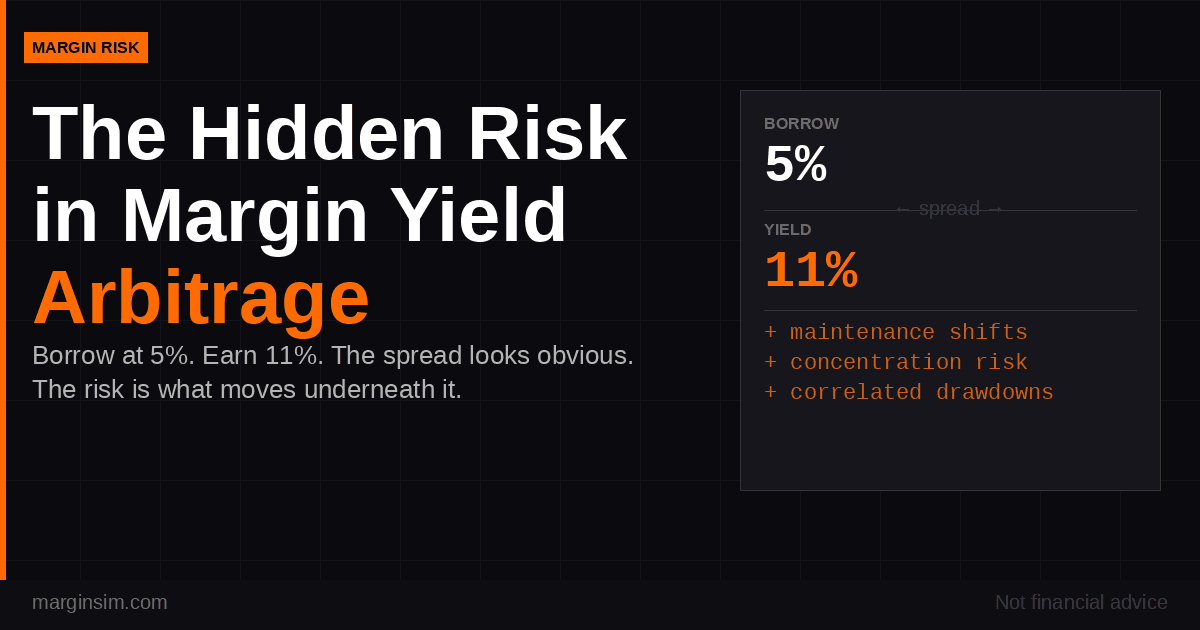
Borrow at roughly 5% Buy an income-producing instrument yielding around 11% Keep the spread
It's hard to argue with the appeal. If your cost of funds is lower than the cash yield you're collecting, why wouldn't you take the trade?
Because once you do it on margin, you are no longer running a simple yield spread. You're running a multi-variable risk system that can change underneath you, sometimes without any price movement in the thing you bought.
That's the hidden risk.
This post isn't a takedown. The basic premise is reasonable. The point is that getting it right requires you to model more than the headline numbers.
Yield arbitrage works… until it doesn't
The "borrow low, earn higher" concept is not new. Institutions do variations of this all the time. Retail traders are just seeing more accessible versions of it in the BTC/MSTR world through newer income structures and MSTR-linked products like STRC, along with a broader ecosystem of covered-call and structured yield instruments.
The issue is not the concept.
The issue is leverage.
Leverage turns a two-line spreadsheet into a set of moving constraints:
- Your equity is changing as prices move
- Your maintenance requirements can change
- Your concentration can change
- The rest of your portfolio can move against you at the same time
When those variables stack up, the "safe spread" trade can become fragile fast.
The MSTY echo: the trade that looked obvious
If this sounds familiar, it should.
At the height of MSTY mania, some people took the yield spread logic and pushed it further than brokerage margin. There were real cases of traders using HELOCs to buy MSTY with the expectation that distributions would cover the debt and produce outsized cashflow.
MSTY is more volatile than STRC. That matters. But the deeper similarity is the mindset:
"The yield will cover the financing, so this is basically self-funding."
The problem is that yield does not protect you from the mechanics of leverage. If you're doing this inside a margin account, your risk is not only about the position you're buying. It's about what the broker requires from your whole account while markets are moving.
The real variables that decide whether you survive
Yield arbitrage trades often focus on two numbers:
- Cost of borrowing
- Cash yield
Those two numbers are real, but on margin they're not the whole model.
In practice, whether the strategy survives is influenced by at least four forces:
- Changes in the price of the income asset
- Changes in margin requirements
- Changes in portfolio concentration
- Price declines in other positions in the portfolio
That last bullet is the one people consistently underweight.
Margin is portfolio math. Losses elsewhere can reduce equity and compress your buffer even if the yield position is flat and still "paying."
The margin dimension: where people get surprised
Here's the part that causes the "how did I get a warning when nothing moved?" moment.
A broker can raise maintenance requirements based on risk and concentration. That means your required equity can increase even when the price of your position is unchanged.
Now add the real-world conditions that tend to show up together:
- The income position dips
- Maintenance requirements tighten
- The position becomes more concentrated as other holdings fall
- Other holdings fall too, pulling down portfolio equity
Each one is manageable in isolation.
Together, they can collapse buffer far faster than a single-variable model suggests.
This is why "I'm earning 11% and borrowing at 5%" is not a complete risk story once margin enters the picture.
Why this matters specifically for STRC in the MSTR ecosystem
If you're coming from the MSTR/BTC universe, you already know volatility is part of the landscape. Even "income" structures tied to this ecosystem sit in the gravitational field of BTC and MSTR sentiment.
There's also a more mechanical detail that matters if you're doing this at a broker like Robinhood.
Many Robinhood users have reported seeing STRC around a 50% maintenance requirement, with cases where it has jumped higher during periods of stress or concentration. Whether your exact number is 50% or something else, the point is the same:
- This isn't a 25% maintenance equity-like assumption you can safely treat as fixed
- It can be meaningfully higher
- It can change at the worst time
So even if STRC is less wild than a YieldMax ETF, you still have to simulate what margin does to the trade when requirements shift and the rest of the book is under pressure.
Modeling the full scenario (without getting too technical)
You don't need a PhD model. You just need to stop thinking in single inputs.
Instead of asking only:
"Is the yield higher than the interest rate?"
Ask questions that reflect real margin behavior:
- What if STRC drops 10–20%?
- What if MSTR or BTC dumps at the same time, pulling down the rest of the account?
- What if maintenance requirements tighten while price is down?
- What if the position becomes a large share of the portfolio because other holdings fell?
- What does forced liquidation look like if you're pushed into it at stress prices?
In real portfolios, these events rarely arrive one at a time. They stack.
If you don't model the stack, you are not modeling the trade you're actually running.
The trade is not "wrong." The assumption of stability is
It's worth repeating: Adam's core observation is directionally right. A positive spread is a positive spread.
The failure mode is not "the spread trade is dumb."
The failure mode is overconfidence about stability:
- assuming maintenance requirements are static
- assuming the rest of the portfolio will behave
- assuming liquidation is a remote edge case
- assuming you can always "just add funds" in time
Sometimes you can. Sometimes you can't. The whole point of stress testing is to see the difference before you're forced to learn it in a drawdown.
Why I built Margin SIM (and why this is the perfect use case)
This exact style of trade is why I've been building Margin SIM.
Not to tell people "don't use margin" and not to hype yield spreads, but to make the leverage mechanics visible:
- Price drop in the target position
- Price drops in other positions in the portfolio
- Concentration effects
- Maintenance requirement shifts
- Liquidation at stress prices
If you're running yield arbitrage inside a BTC/MSTR portfolio, you're not running a one-position trade. You're running a portfolio system with multiple failure paths.
Stress testing is the difference between "this looks obvious" and "this survives."
If you're actively doing margin in this ecosystem and you want to pressure test these scenarios, you'll probably find it useful. I'm also recruiting a small number of serious early users who will actually engage and give thoughtful feedback. If it earns its place in your workflow, you'll receive a lifetime Pro upgrade.
Not financial advice
This article is for informational and educational purposes only and does not constitute financial, investment or trading advice. Margin and leverage involve significant risk, including the potential loss of more than your initial investment. You are responsible for your own decisions. Consider consulting a qualified financial professional before acting on any strategy discussed here.