The Margin Ratio Bump: The Risk MSTR and YieldMax Holders Aren't Modeling
- margin
- MSTR
- YieldMax
- margin ratio
- maintenance margin
There's a margin risk that almost no calculator models, and almost no trader thinks about until it happens to them.
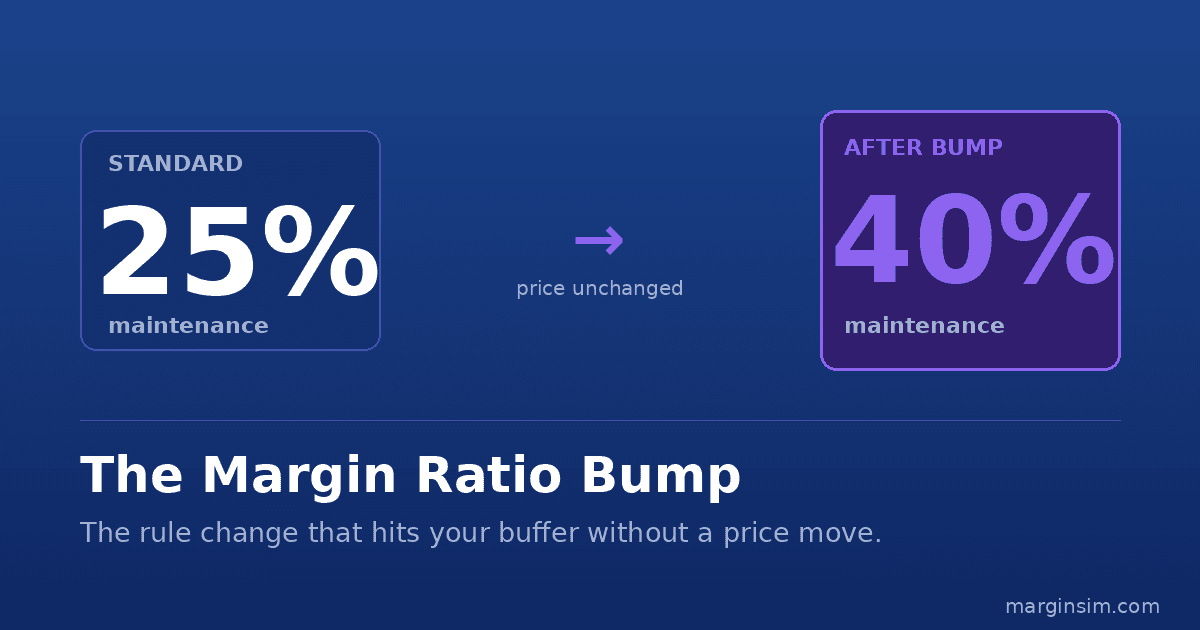
Your broker can raise the maintenance margin requirement on a stock you already own — without the price moving at all. Your portfolio value stays the same. Your margin requirement goes up. And your buffer drops, potentially below the threshold that triggers a call.
This is called a margin ratio bump, and it's a particular risk for holders of MSTR, MSTY, and other high-volatility or income-focused ETFs on margin.
What Margin Ratio Requirements Actually Are
Every marginable security has a maintenance margin requirement — the minimum percentage of equity you must hold relative to the position's value. The standard requirement for most stocks is 25%. That means for every $1,000 of TSLA you hold, you need at least $250 of equity to support it.
But "standard" doesn't mean "fixed." Brokers set their own house margin requirements on top of the regulatory minimums, and they can change them at any time. Robinhood — like most brokers — reserves the right to raise maintenance requirements on individual securities whenever they judge the risk warrants it.
They don't have to notify you in advance. They don't need the price to move. They just change the requirement, and your math changes with it.
Why MSTR and YieldMax ETFs Are Particularly Exposed
Not all stocks sit at 25% maintenance. High-volatility stocks and certain structured products attract elevated requirements from the start — or get bumped to them during periods of market stress.
MSTR is a common example. It can carry maintenance requirements of 40%, 50%, or higher during periods of elevated volatility — roughly double the standard rate. This reflects the stock's historical price swings and its leveraged Bitcoin exposure.
YieldMax ETFs like MSTY (a covered-call strategy on MSTR) carry similar elevated requirements. These are income-focused products with exotic structures, and brokers price in the volatility accordingly.
Here's why this matters more than most traders realize: if you built your margin position assuming 25% maintenance and your broker bumps the requirement to 40%, you haven't made a bad trade. The price hasn't moved. But your buffer has dropped — possibly significantly — purely because the rules changed.
The Concentration Factor: Your Rate May Be Higher Than Your Neighbor's
Here's the part most traders never see coming: Robinhood doesn't just look at what you hold — it also looks at how much of it you hold relative to your total portfolio.
A trader with 5% of their portfolio in MSTY might see a maintenance requirement of 35%. A trader with 60% of their portfolio in MSTY might see 70% — on the same security, on the same day.
This concentration-based adjustment is Robinhood's way of pricing in position risk alongside security risk. A heavily concentrated position in a volatile holding creates a different risk profile than a diversified one, and the maintenance rate reflects that.
The practical implication: you can't look up "the MSTY maintenance rate" and know your number. Your rate is specific to your portfolio composition. Two traders comparing notes on MSTY margin might be looking at completely different requirements — and neither would be wrong.
This is why modeling your actual buffer requires your actual positions, not generic rates.
A Worked Example
Consider this portfolio held on margin:
| Position | Value | Standard Maintenance (25%) | Bumped Maintenance (40%) |
|---|---|---|---|
| MSTR | $20,000 | $5,000 | $8,000 |
| MSTY | $15,000 | $5,250 (35%) | $7,500 (50%) |
| TSLA | $10,000 | $2,500 | $2,500 |
| BTC | $5,000 | $5,000 (100%) | $5,000 (100%) |
| Total maintenance | $17,750 | $23,000 |
Assume margin equity of $25,000 (total account value $75,000, margin debit $50,000).
Before the bump: Buffer = ($25,000 − $17,750) / ($25,000 − $5,000) = $7,250 / $20,000 = 36.3%
After MSTR and MSTY maintenance bumps — no price movement: Buffer = ($25,000 − $23,000) / ($25,000 − $5,000) = $2,000 / $20,000 = 10%
The buffer dropped from 36% to 10% with zero change in market prices. A further 5% dip in MSTR at that point would be enough to breach the maintenance threshold.
This is not a hypothetical. It happened to accounts holding MSTR during the 2024 volatility events, and it will happen again.
The Three-Direction Problem for Crypto-Linked Holdings
Positions like MSTR and MSTY hit your margin buffer from three directions simultaneously.
Direction one: price volatility. These are high-beta positions. When Bitcoin drops, MSTR drops harder. When MSTR drops, MSTY's covered-call income collapses.
Direction two: maintenance requirement increases. During the same volatility event that drops the price, your broker may also raise the maintenance requirement on the security — compounding the buffer impact.
Direction three: concentration-based rate adjustments. If a volatile position becomes a larger share of your portfolio as prices shift — or if Robinhood recalculates concentration at the same time — your rate can increase further, purely because of how much of your portfolio is exposed to that one name.
Modeling only price drops — which is what most calculators do — misses most of the picture. A complete margin stress test needs to account for all three: what happens to your buffer if the price falls, the maintenance rate rises, and concentration-based adjustments kick in at the same time.
What This Looks Like in Practice
The scenario to model is: "What if Robinhood raises maintenance on MSTR from 25% to 40% tomorrow?"
Walk through the math for your actual positions:
- Take your current equity
- Set a custom maintenance rate for your elevated positions — 40%, 50%, or whatever scenario you want to test
- Enter your positions into Margin SIM — it applies Robinhood's buffer formula automatically and shows your buffer in real time
- Check how close that puts you to the margin call threshold — and whether a concurrent price drop would breach it
If the answer is "very close," you're carrying a risk that doesn't appear in your current account view — because the bump hasn't happened yet.
How Much Buffer Do You Actually Need?
There's no universal answer, but the practical question is: how much buffer remains after a realistic bump scenario, and is it enough to absorb a concurrent price drop?
A 40% maintenance requirement on a position that's simultaneously down 15% on price means your buffer is taking hits from both sides at once. Traders who plan for price drops but ignore maintenance bumps are planning against a partial model of their actual risk.
The margin ratio bump is one of the least-discussed risks in leveraged and income-portfolio strategies. It's invisible until it hits, it doesn't require a market event to trigger, and it can push a well-structured position into call territory without warning.
If you hold MSTR, MSTY, or any elevated-maintenance security on margin, modeling a ratio bump alongside your price scenarios is part of understanding your actual risk exposure.
For scenario modeling that includes margin ratio bumps — you can set a custom maintenance rate for any position and see the buffer impact immediately — the Margin SIM sandbox is free, requires no account, and loads a demo portfolio by default.
Margin SIM does not provide financial advice. All calculations are for educational and scenario modeling purposes only. Robinhood Mode matches Robinhood's methodology — it is not a partnership or endorsement.