Why Buying Power Is a Dangerous Number to Trust
- margin
- Robinhood
- buying power
- margin call
- maintenance margin
- risk
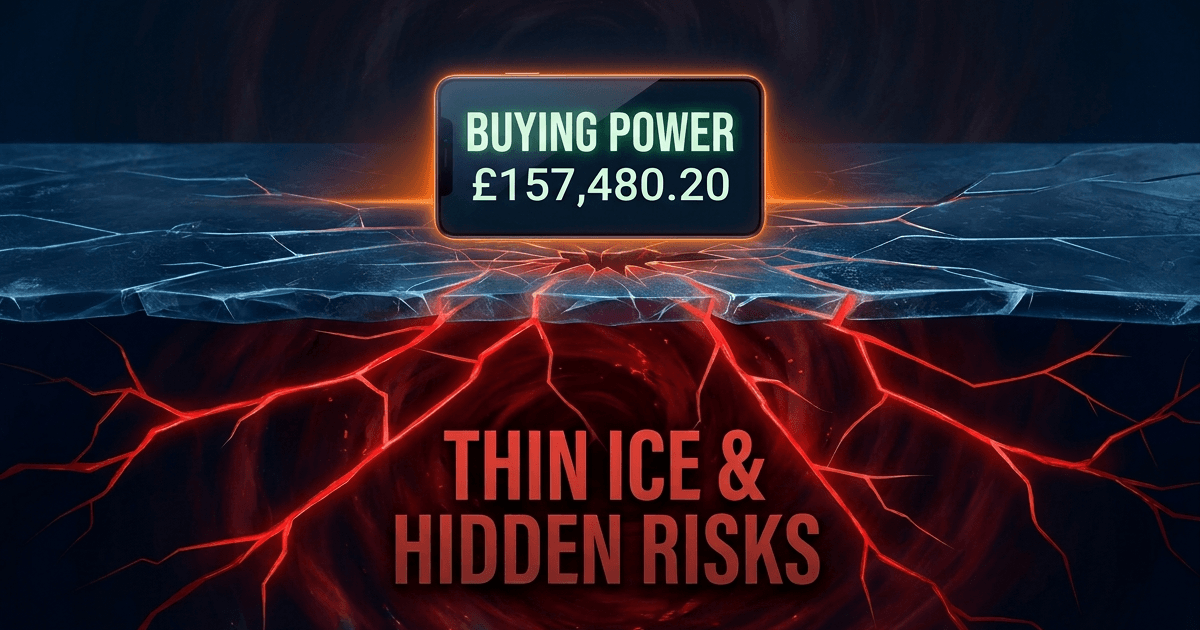
Why Buying Power Is a Dangerous Number to Trust
For a lot of Robinhood margin traders, buying power becomes the comfort number.
It is visible, simple, and always there. It tells you what you can still buy, so it starts to feel like a measure of safety.
It is not.
That is the mistake.
Buying power is a broker interface number. It is not a risk number. It does not tell you how close you are to forced selling. It does not tell you how fragile your account becomes if maintenance requirements change. It does not tell you what happens when a concentrated position drops fast.
A trader can have buying power and still be sitting on a weak margin structure.
That matters more than most people think.
What Buying Power Actually Tells You
Buying power answers a narrow question:
What can I still purchase under current broker rules and current account conditions?
That is useful, but it is not the same as asking:
- How close am I to a margin call?
- How much would my buffer shrink in a selloff?
- What happens if Robinhood raises a maintenance requirement?
- What happens if correlated positions drop together?
- At what point does this stop being my decision?
Those are the real questions.
Why Buying Power Creates False Confidence
Buying power is easy to read, so traders start using it as emotional reassurance.
That is where things go wrong.
A trader sees buying power and starts thinking:
- I still have room
- I am not close to trouble
- I can add if it dips
- I am not overleveraged
That logic feels good and can still be completely wrong.
Buying power is a permission number.
Margin safety is a survivability question.
Those are not the same thing.
What Buying Power Hides
The danger is not that buying power is fake. The danger is that it is incomplete and traders treat it like it tells the whole story.
It does not.
Maintenance Requirements Can Change
A trader sees buying power and assumes the setup is stable.
Bad assumption.
A broker can change maintenance requirements on a position or class of positions. If that happens, your account can become meaningfully weaker without a dramatic move in the stock itself.
That is why “I had room yesterday” means nothing.
You had room under yesterday’s conditions.
Correlated Positions Can Get Hit Together
A margin account can look diversified and still behave like one trade.
If you hold positions that tend to move together, the account can weaken much faster than expected. The buying power number does not explain that risk. It just updates after the damage starts.
That is too late.
Concentration Can Turn a Normal Drop Into a Real Problem
One oversized position can make an account far more fragile than the buying power display suggests.
That is especially true when a trader is emotionally attached to the name and keeps reading buying power as reassurance.
It is not reassurance. It is just a current-state number.
Forced Selling Risk Is Not Shown Directly
This is the biggest miss.
Traders know their cost basis. They know their yield & margin interest rate.
A shocking number do not know the approximate level where forced selling becomes likely.
That is degen territory.
If you are using margin and you do not know the line where the account stops being your decision, you do not understand your risk.
The Better Number to Watch
Not buying power.
Buffer.
Call it margin buffer, liquidation buffer, distance to trouble, whatever you want. The point is the same: you need to know how much room exists between your current account state and a margin call or forced-sell situation.
That buffer should be stress-tested, not admired.
You want to know what happens if:
- the position drops
- multiple positions drop together
- maintenance requirements rise
- concentration gets treated more harshly
- more than one of those things happens at once
That last one is where people get wrecked.
They model one variable. Real accounts break under combinations.
A Simple Shift in Thinking
Stop asking:
How much can I still buy?
Start asking:
How much stress can this account actually absorb?
One question is about offense.
The other is about survival.
Margin traders who confuse those two are usually one bad sequence away from finding out the hard way.
Why This Matters on Robinhood
Robinhood makes it especially easy to think in terms of:
- available money
- next buy
- average cost
- easy leverage
That clean interface can create fake confidence.
A trader can be staring at buying power while ignoring the actual mechanics of the account. Then the market moves, or a requirement changes, or the account gets squeezed from more than one direction, and suddenly “room” turns out to be something very different from resilience.
That lesson usually arrives late.
What Margin Traders Should Do Instead
If you use margin, stop treating buying power as your comfort metric.
Look at the account like a stress system.
Test:
- price shocks
- maintenance changes
- concentration effects
- combined scenarios
Know where your real danger zone starts. Know how fast your room disappears. Know what assumptions your confidence depends on.
Because if your peace of mind comes from a buying power number, you probably do not understand your account as well as you think.
And on margin, that is not a small mistake.
It is the mistake.
Final Thought
Buying power tells you what the broker may let you do next.
It does not tell you how close the broker is to doing something to you.
That is the distinction that matters.
If you trade on margin, stop using buying power as your safety metric.
Use stress-tested buffer instead.
Not financial advice
This article is for informational and educational purposes only and does not constitute financial, investment or trading advice. Margin and leverage involve significant risk, including the potential loss of more than your initial investment. The yield figures and maintenance rate examples referenced here are illustrative and reflect reported market conditions at the time of writing — they are subject to change. Robinhood's margin requirements and policies may change; refer to Robinhood's current terms and margin disclosure for current information. You are responsible for your own trading decisions. Consider consulting a qualified financial professional before acting on any strategy discussed here.